Most businesses know they should be using AI. Far fewer know where to begin. The good news is that a first project does not need a big strategy or a big budget. It needs the right process, an honest baseline and 90 days of focus. Here is the plan we use with clients.
Where do Maltese businesses stand with AI today?
Eurostat’s 2026 report on AI use in enterprises shows that 21.6% of Maltese enterprises with 10 or more employees used at least one AI technology in 2025, slightly above the EU average of 20.0%. The gap by size is striking: 52.2% of large Maltese enterprises used AI, compared with 30.7% of medium and 17.9% of small ones.
Meanwhile, the same report puts Malta among the EU countries with the highest share of individuals using generative AI tools, at 46.5%. In other words, many of your staff are probably already using AI personally. The opportunity is to turn that informal use into reliable business processes.
Why do so many AI projects stall?
Among EU enterprises that considered AI but did not use it, Eurostat found the most common barrier was a lack of relevant expertise, cited by around 71%. Legal uncertainty and data protection concerns followed. In our experience, projects also stall because they start with a tool rather than a problem, or pick a process too complex or too rare to show results quickly.
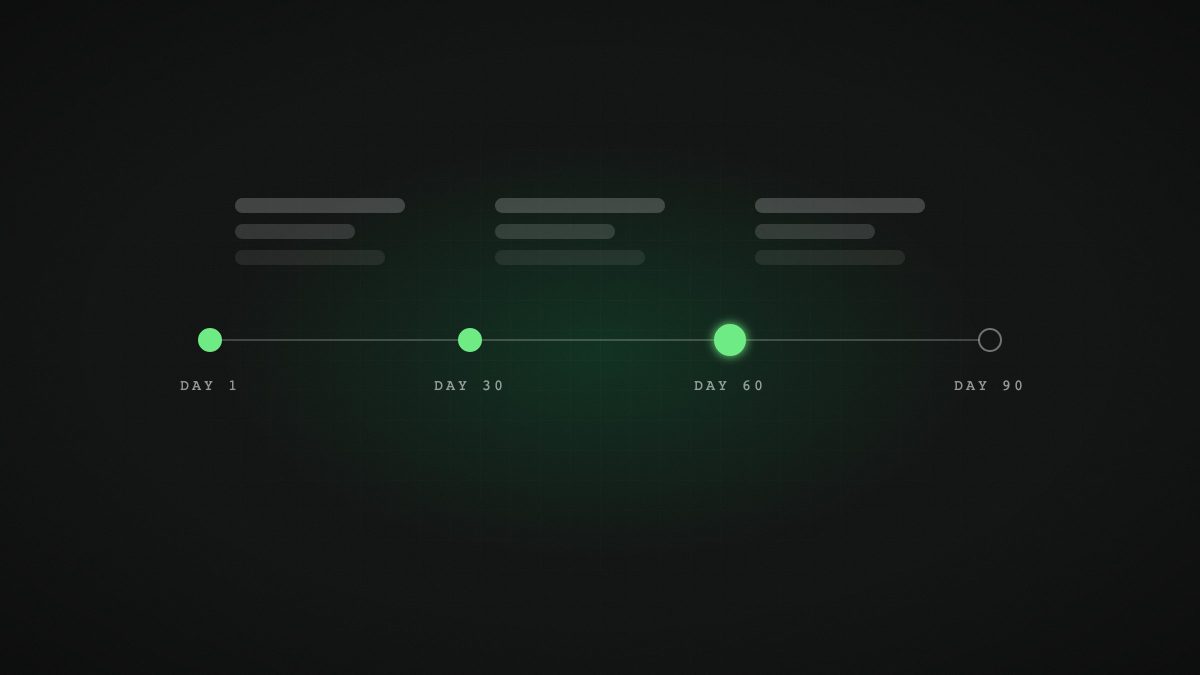
Days 1 to 30: How do you pick the right first process?
Spend the first month choosing well. List the tasks your team repeats every week and score each against five questions:
- Volume: does it happen dozens or hundreds of times a month?
- Rules: could you explain to a new hire how to do it in a page or two?
- Inputs: does it start from something digital, such as an email, PDF, form or spreadsheet?
- Cost of errors: can mistakes be caught before they cause harm?
- Measurability: can you count time, volume and error rates today?
Good first candidates we see again and again:
- Keying supplier invoices or delivery notes into the accounting or stock system.
- Sorting and routing a shared inbox, and drafting replies to routine queries.
- Preparing quotes from a standard price list and a customer request.
- Chasing missing documents from clients or applicants.
- Copying data between two systems that do not talk to each other.
These map directly onto automating repetitive work, processing documents with AI and connecting your systems.
Measure the baseline
Before building anything, record how long the process takes per item, how many items you handle per month, how often errors occur and what they cost to fix. Two weeks of simple tracking is enough. This baseline is what turns “it feels faster” into a business case.
Days 31 to 60: What does a good pilot look like?
Build the smallest version that handles real work. A good pilot:
- Runs on live items, not a demo set, with a person reviewing every output at first.
- Logs everything: what came in, what the AI produced, what the reviewer changed.
- Handles exceptions honestly. When the AI is unsure, it should say so and hand over, not guess.
- Fits existing tools. Staff should see results where they already work, in email, the ERP or a shared sheet, rather than learning a new system.
Expect the first weeks to reveal messy inputs and unwritten rules. That is normal and valuable: you are documenting how the process really works.
Days 61 to 90: How do you prove value and decide what next?
By month three you should have enough data to answer three questions:
- Accuracy: what share of items went through without correction?
- Time: how much reviewer time does each item now take, compared with the baseline?
- Cost: what does the system cost to run per item, including AI usage and maintenance?
If accuracy is high and stable, reduce review to sampling and exceptions. If it is not, fix the inputs or narrow the scope before scaling. Then pick the next process, ideally one that reuses the same data connections.
Research supports starting with assisted work rather than full autonomy. A large study of customer support staff by Brynjolfsson, Li and Raymond, published through the National Bureau of Economic Research, found that an AI assistant raised issues resolved per hour by 14% on average, and by 34% for novice and less-skilled workers. The biggest gains came from helping people, not replacing them.
How much does a first AI automation project cost?
It depends on the process, the systems involved and the volume, so beware anyone who quotes before understanding your workflow. What we can say is that a tightly scoped first project is usually far cheaper than a broad “AI transformation”, and that running costs for AI models have fallen sharply in 2026. The right comparison is cost per item against the fully loaded cost of the manual work it replaces. Our page on reducing costs and increasing capacity explains how we frame that.
Can I get funding for an AI project in Malta?
Possibly. Call 2 of the Digitalise Your SME scheme opened on 1 July 2026 with a €15 million budget and cut-off dates every 15 days to the end of the year, subject to funds, according to Deloitte Malta. The base grant goes up to €128,400, covering 50% of eligible costs in Malta and 60% in Gozo. Projects that include AI may receive up to €107,000 more, for a total of up to €235,400, with the AI element paid one year after completion subject to a productivity gains report and an ethical AI report. Check current terms before applying; our funding support team can help.
Frequently asked questions
What is the best first AI automation project for a small business?
A repetitive, rules-based, high-volume task with digital inputs and measurable outcomes, such as keying invoices, routing a shared inbox or preparing standard quotes.
How long does it take to see results from AI automation?
A well-scoped pilot can handle live work within weeks. Ninety days is a realistic period to choose a process, run a pilot on real items and gather enough data to judge the return.
Do I need clean data before starting with AI?
You need usable inputs for the chosen process, not perfect data across the business. Many first projects involve reading documents and emails that are already digital, and the pilot often reveals which data fixes are worth making.
Will AI automation replace my staff?
In most SMEs the first gains come from removing repetitive work so people can focus on customers and exceptions. Research on customer support found the biggest productivity gains for less experienced staff working with AI assistance.
Ready to find your first process? Book a free discovery call with Haystack and we will help you choose one worth automating.